

If your dentist has recently mentioned that you might need a crown or a bridge, and you nodded along politely while mentally making a note to Google it later, this blog is for you.
Both are common, effective, and restorative treatments that solve real dental problems. But they solve different problems, work in different ways, and are recommended for different situations. Understanding the distinction helps you walk into your next appointment with clarity instead of confusion, and make a genuinely informed decision about your own dental health.
Let's break it down properly.
What Is a Dental Crown?
A dental crown is a custom-made cap that fits over an existing tooth, covering it entirely from the gum line upward. Think of it as a protective shell that restores a damaged, weakened, or aesthetically compromised tooth to its original shape, size, and function.
The tooth beneath the crown remains intact and functional, simply reshaped to fit the crown. Crowns provide a stronger, more attractive exterior and are recommended for various situations, such as large cavities, cracked teeth, post-root canal protection, and misshapen or discolored teeth. In each case, the underlying tooth is still there; it just needs a crown for proper support.
At Om Datta Dental Clinic, dental crowns and bridges in Ghatkopar are made from a range of materials, including ceramic, zirconia, porcelain-fused-to-metal, chosen based on the tooth's location, your bite, and your aesthetic preferences. Your dentist will walk you through the options before any decision is made.
What Is a Dental Bridge?
A dental bridge does something fundamentally different: it replaces a tooth that is no longer there.
When a tooth is lost or extracted, and the gap is left unfilled, the surrounding teeth begin to drift toward the empty space. The opposing tooth loses its chewing partner and can over-erupt. Bone beneath the gap begins to resorb. What starts with one missing tooth can gradually create a cascade of problems throughout the mouth.
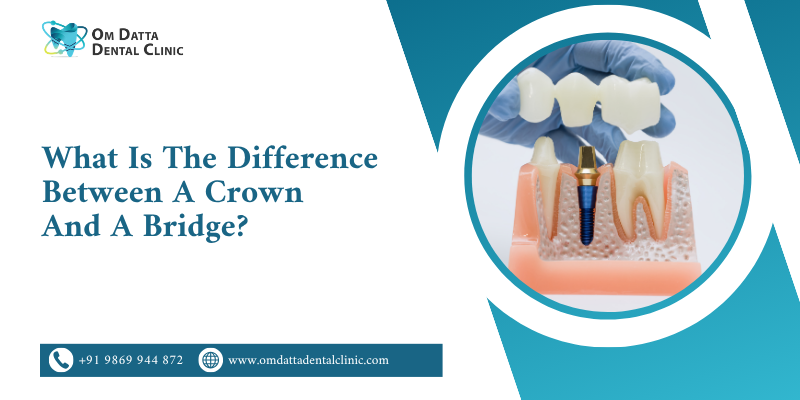
A bridge fills that gap with an artificial tooth, called a pontic, held in place by crowns fitted over the natural teeth on either side of the space. Those supporting teeth are called abutment teeth, and they do exactly what the name suggests: they anchor the bridge and hold the replacement tooth firmly in position.
The result is a fixed, non-removable restoration that looks, feels, and functions like a natural tooth. You eat with it, clean around it, and largely forget it's there, which is exactly how good dental restoration should feel.
Dental crowns and bridges in Ghatkopar at Om Datta Dental Clinic are crafted with precision, matched to your natural tooth colour, shaped to your bite, and fitted with the kind of attention to detail that makes the difference between a restoration that merely functions and one that genuinely feels like part of your mouth.
The Core Difference
Here is the simplest way to hold the distinction:
A crown protects a tooth that is still there. A bridge replaces a missing tooth.
A crown works on a single damaged tooth; one crown is placed over it. A bridge works as a unit with one missing tooth, two crowns on either side, and one artificial tooth suspended between them.
Both use crowns in their construction. This is why the two treatments are so frequently mentioned together and so commonly confused. But their purpose, their indication, and their clinical approach are distinct.
How Do You Know Which One You Need?
This is ultimately a clinical question that your dentist will answer after examining your teeth, reviewing X-rays, and understanding your specific situation. But there are some general patterns worth knowing.
You are likely to need a crown if: Your tooth is present but significantly damaged, cracked, or weakened. You have recently had a root canal on a back tooth. You have a large old filling that has failed, and the remaining tooth structure is insufficient for a new filling. You have a tooth that is structurally compromised but still has a healthy root.
You are likely to need a bridge if: You have a missing tooth with healthy natural teeth on both sides of the gap. You are not a candidate for a dental implant, or you prefer a fixed non-implant solution. You had a tooth extracted some time ago, and the gap has been left unfilled. Your dentist has identified that the surrounding teeth are beginning to shift toward the space.
There are also situations where an implant is worth discussing alongside a bridge, particularly for younger patients or those with a single missing tooth and healthy adjacent teeth. At Om Datta Dental Clinic, we take the time to explain every option clearly, because the right choice depends entirely on your individual clinical picture and your long-term goals.
What Does the Procedure Look Like for Each?
For a crown: The tooth is numbed, gently reshaped, and an impression or digital scan is taken. A temporary crown is placed while the permanent one is being crafted, usually for one to two weeks. At the second appointment, the permanent crown is fitted, adjusted, and cemented. Two visits, minimal discomfort, lasting result.
For a bridge: The two abutment teeth on either side of the gap are numbed and prepared in the same way as for individual crowns. An impression of the full span is taken, capturing both abutment teeth and the gap between them. A temporary bridge is installed while the permanent one is being built. At the second appointment, the permanent bridge is fitted and cemented as one connected unit. Again, two visits and a gap that has been closed permanently.
Both treatments are well-tolerated, routinely performed, and deliver results that last a decade or more with proper care.
Caring for Your Crown or Bridge
Crowns and bridges don't require dramatically different care from your natural teeth, but a few habits make a meaningful difference in how long they last.
Brush twice daily as normal. For a bridge, flossing requires a little more care; a floss threader or interdental brush helps clean beneath the pontic where a regular floss can't reach. Avoid using your crowned or bridged teeth to open packaging or bite into extremely hard foods. And attend your regular check-ups at Om Datta Dental Clinic because catching minor issues early keeps them from becoming major ones.
With consistent care, dental crowns and bridges in Ghatkopar placed at Om Datta Dental Clinic routinely last fifteen years or more. Many last significantly longer.
FAQs
Q1. Can a bridge be done immediately after a tooth extraction?
Typically, a bridge is not placed immediately after tooth extraction. The gum and bone need about six to eight weeks to heal before the bridge can be fabricated. Placing a bridge too soon can lead to a poor fit due to changes in gum shape during healing. Your dentist at Om Datta Dental Clinic will recommend the best timing for you and may provide a temporary restoration to protect the area in the meantime.
Q2. Is a bridge better than an implant for a missing tooth?
Neither option is universally better; they suit different situations and patients. An implant replaces both the tooth root and crown, preserving the jawbone without affecting adjacent teeth. A bridge is quicker, less invasive, and more affordable, but requires reshaping neighboring teeth and doesn’t prevent bone resorption over time. For those with healthy adjacent teeth and enough bone, implants are often preferred. For patients who are not suitable for implants or who need crowns on adjacent teeth, a bridge is a valid option. Your dentist will help you evaluate both options.
Q3. How long does it take to get used to a new crown or bridge?
Most patients adapt to a new crown or bridge within one to two weeks. Initially, you may notice a slight difference, such as mild sensitivity or a minor bite adjustment. If your bite feels uneven after the first week, a quick adjustment at Om Datta Dental Clinic can help. Report any persistent sensitivity or discomfort beyond two weeks to your dentist, as it may indicate the need for a minor refinement.